
Andean Scapes team · Updated
Emerald mine tours in Colombia: a practical 2026 guide
Almost every "emerald tour" at the top of Google happens in Bogotá, among jewelers and the traders of Avenida Jiménez. Going into a mine is something else: you travel to the mining regions, put on a helmet and boots, and accept that no stone may turn up. This is how it works in Chivor.
What is an emerald mine tour?
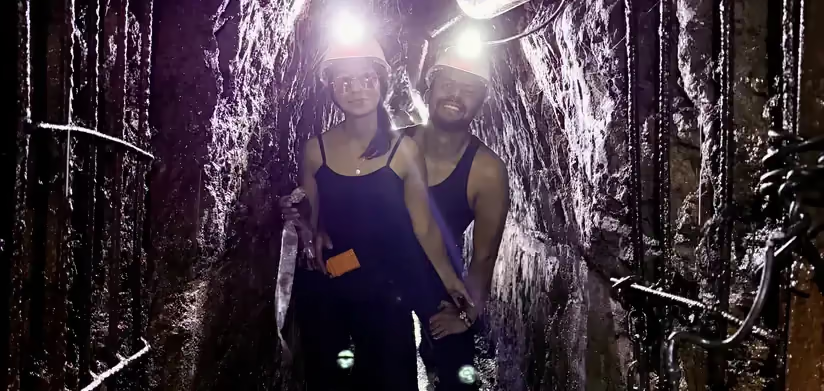
It is a guided visit to a working emerald mine, alongside local miners. The mines we visit in Chivor are real emerald mines: some are worked by hand and others at a larger scale. They are not coal mines or mock-ups built for tourists. It is what many people look for as "miner for a day": a day alongside the miners, not a job.
You enter with a local guide, a helmet and boots. Time underground is only part of the day, which also includes the 4x4 ride up from town, preparation and, depending on the tour, hiking or horseback riding along the mining trails. Finding an emerald is possible but never guaranteed.
This is different from the emerald tours in Bogotá, which show the trade, cutting and jewelry in the city but never enter a mine. To see where the stone comes from, you have to travel to the mining regions.
Where are the emerald mines in Colombia?
Colombian emeralds come from two belts in the Eastern Andes. The western belt, in western Boyacá, includes Muzo, Coscuez, Maripí, Quípama, Otanche, Pauna and San Pablo de Borbur. The eastern belt includes Chivor, Somondoco, Macanal and Guateque in Boyacá, and Gachalá and Ubalá in Cundinamarca.
They are separate destinations, several hours apart by road, so they don't combine well in a short trip. Chivor is considered the source of the first emeralds that left the Americas after the Spanish conquest, and in 1967 Gachalá produced one of the world's most famous emeralds, an 858-carat crystal. By department, almost all are in Boyacá; in Cundinamarca there are mines in Gachalá and Ubalá, in the Guavio region.
Why visit Chivor
Chivor sits at about 2,000 meters above the Sinaí valley, which further down becomes the Guavio river, with a cool climate and cold nights. From the El Púlpito viewpoint, just below the mines, you can see towards the Eastern Plains (Llanos) on clear days.
Beyond its history, which runs from the Muisca peoples to the mining engineer Peter W. Rainier and his book Green Fire, Chivor lets you enter active mines with miners from the community. Our base is Hacienda El Recuerdo in Mundo Nuevo (Ubalá), very close to Chivor, a cattle and beekeeping farm where guests stay on the two-day tours.
This is not a trip to the Salt Cathedral
The Salt Cathedral of Zipaquirá is an hour from Bogotá, with parking, restaurants and buses every few minutes. An emerald mine is another matter. Chivor is about 160 to 180 km from the capital, depending on the route, which means 5 to 6 hours on the road; western Boyacá is just as far or farther. The mine entrances are not in town: you reach them on unpaved mountain tracks that a regular car will not climb.
That makes transport the hardest part of the trip. Tourism in the region is still small, there is no transfer market like in the big destinations, and what works is a 4x4 with a driver from Bogotá. That driver works a full day out and another back, and it shows in the price. Our private 4x4 transfer, round trip Bogotá–Chivor–Bogotá, costs 1,700,000 COP per vehicle and carries up to 4 people (reference price as of November 2026). For a couple on the two-day tour, at 475,000 COP per person, the transport costs more than the tour itself. You can also take a bus to Chivor town, the cheapest option, and ride up from there in our local 4x4.
The other problem is where to sleep and eat. Chivor is a small municipality with few hotels and few restaurants, and the mine is far from the town center. Arrive on your own and you have to sort out lodging, meals, transport to the mine entrance and the mine visit separately, each with a different provider and with little phone signal to coordinate them.
An all-inclusive tour settles those pieces at once: a night at Hacienda El Recuerdo, meals, local 4x4 transport and the mining day, with no middlemen between you and the people of the region. And you spend the trip with hosts and guides who live there, who can change the plan when it rains and who know what no map shows. You can put it all together yourself, of course; just expect more phone calls and more surprises.
How to get to Chivor, Boyacá, from Bogotá
From Bogotá, take the road towards Tunja; at El Sisga, turn right down into the Tenza Valley and continue to Chivor, without going on to Tunja. Near Macanal you cross the La Esmeralda reservoir by ferry during its operating hours, or drive around it. The trip takes about 5 to 6 hours, because the last stretch is an unpaved mountain road.
You can reach Chivor town by bus, car or motorbike; from there, the local 4x4 ride to the mine is included in every tour. If you would rather not drive, we offer a private round-trip 4x4 transfer from Bogotá at extra cost; the price is per vehicle and covers up to 4 people.
An alternative route via Ubalá, in the Guavio region, is only suitable for a motorbike or a 4x4: it is about 35 km of rural road to the hacienda. With a regular car, the right option is to arrive via Chivor town.
What happens inside the mine
The day starts with a talk with local miners and artisans about how emeralds are found. Then you are given safety gear and enter the tunnels with your guide, where there is water, mud and uneven ground.
Inside, you see how the miners work, how a vein is followed and which minerals come with the emerald. The two-day tours also include an emerald workshop of about an hour on how the stone is graded.
If an emerald turns up during the visit, it is agreed on the spot with the miners and the guide, who share what is found. The value of the experience lies in the emerald culture, nature and food of the region, not in the find.
How to choose your tour
The day trip includes one mine and a hike in a single day. It is doable, but it is a long day: you leave Bogotá before dawn and add another 5 to 6 hours to drive back.
The 2-day/1-night tour includes one mine, a hike, the workshop, a night at Hacienda El Recuerdo and 4 meals. The most complete tour adds a second mine and a guided horseback ride of about 2 hours.
The minimum age is 5, and dogs can join the group inside the mine in Chivor. If you have reduced mobility, a heart condition or a severe phobia, ask us before booking.
Safety, Chivor weather and what to bring
You always enter with a guide and safety gear, in mines with controlled access, and every tour includes medical assistance cover during the experience. The team checks local and mine conditions before each departure.
The dry season runs from December to February and the rainy season from May to August. Bring shoes that can get wet and muddy, a full change of clothes, a small towel, a light or waterproof jacket, water, sunscreen and cash for local expenses.


