
Andean Scapes team · Updated
History of the Chivor emerald mine: from Somondoco to Green Fire
Chivor was one of the first emerald sources the conquistadors knew, lay lost under the forest for two centuries and lived a second age of adventure in the 1920s. This is its story, based on research published by the Gemological Institute of America (GIA).
Somondoco: emeralds before the conquest
When the Spanish reached the Eastern Andes, the Chibcha (Muisca) peoples were already wearing emeralds in their jewelry. The deposit we now call Chivor was known as Somondoco, after the nearby village where the stones were sorted.
According to the historians cited by GIA, emeralds from this area were traded long before the conquest, and Chivor is considered the source of the first emeralds that left the Americas for the rest of the world.
1537: Valenzuela's expedition
In 1537, Gonzalo Jiménez de Quesada learned of the Somondoco mines and sent captain Pedro Fernández Valenzuela to find them. Valenzuela reported that, from the heights of the mines, he could see the Orinoco plains through an opening in the range. That detail would prove decisive centuries later.
The Spanish worked Chivor through the 16th and 17th centuries with indigenous labor, devastated within a few decades. A royal decree of 1593 ordered humane treatment of the miners; in 1602 Philip III demanded it be enforced, by which time it was too late. The first recorded concession dates from 1592. In 1672 the mine was abandoned by order of the Crown, and the forest covered it for about two hundred years while attention moved to Muzo.
1896: Francisco Restrepo's rediscovery
In the late 19th century, the Colombian mining engineer Francisco Restrepo studied, in the National Library, the friars' chronicles describing the lost Somondoco mines. After some eight years of searching the range, he found the mine in 1896: the decisive clue was the view towards the plains.
From 1911 the German Fritz Klein, from Idar-Oberstein, worked there and in 1925 published the first detailed account of the mine, Smaragde unter dem Urwald (Emeralds Under the Jungle). In the early 1920s Chivor yielded the Patricia emerald, a 632-carat crystal now on display at the American Museum of Natural History in New York.
Peter W. Rainier and Green Fire
Peter W. Rainier, a mining engineer born in southern Africa in 1890, managed Chivor from 1926 to 1931 for a New York company. On arrival he drove an iron stake into El Púlpito to mark the edge of the concession. When the board ordered him to close the loss-making mine, he kept working, and within a week the first vein appeared.
After the 1929 crash his employers closed the mine. Rainier stayed in the region and, with his wife Margaret, founded Las Cascadas, a tea plantation on the slopes of the Guavio valley about 15 km from Chivor, described as the first commercial tea plantation in South America. When he was at the mine, the couple signaled each other with flashlights every night.
In 1942 he published his memoir, Green Fire. John Sinkankas, author of the major annotated bibliography of gemology, called it "colorful, sometimes sensational", yet full of valuable detail. In 1954 MGM released a film of the same title starring Grace Kelly and Stewart Granger.
El Púlpito: the viewpoint over the plains
El Púlpito is a sandstone monolith hanging over the Sinaí river valley, just below the mine. Further down, the Rucio and Sinaí rivers join to form the Guavio.
From here you can see the gap in the mountains that looks out to the Eastern Plains, the same view Valenzuela described in 1537 and that guided Restrepo in 1896. In 2015 a GIA team retracing Rainier's steps found the hole left by his iron stake in the rock. The viewpoint is part of our day trip.
Chivor today: where the mines are
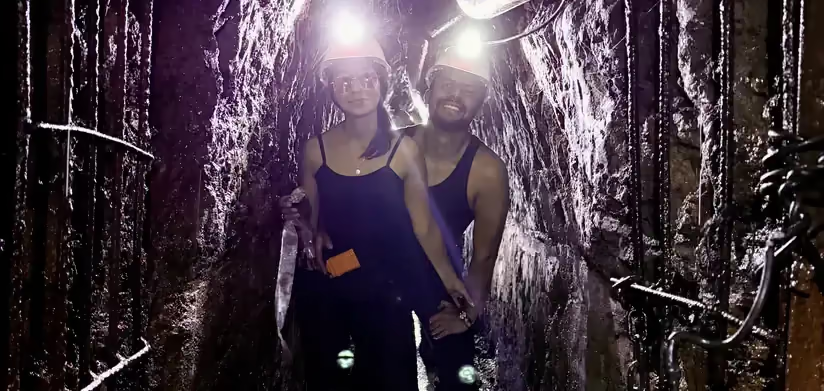
Today mining in Chivor is mostly done in underground tunnels, in mines of different scales along the Sinaí valley. Emeralds form in veins within Cretaceous black shales, and chromium and vanadium give them the slightly bluish green that characterizes Chivor stones. The mines lie in the municipality of Chivor, in the Oriente province of Boyacá. The town is the starting point; you ride up to the mine entrances by 4x4.
Miners have their own vocabulary: chispas are small, intensely colored crystals and gotas de aceite (oil drops) are the finest. At the mine you will hear both words before you see a single stone.
Sources
- Weldon, R., Ortiz, J. G. & Ottaway, T. (2016). In Rainier’s Footsteps: Journey to the Chivor Emerald Mine. Gems & Gemology, 52(2). GIA.
- Schmetzer, K. & Martayan, G. (2020). History of the Chivor Emerald Mine, Part I (1880–1925). Gems & Gemology, 56(1). GIA.
- Rainier, P. W. (1942). Green Fire. New York: Random House.


