
Andean Scapes team · Updated
Episode 1. Oriente: Chivor, Gachalá and Green Fire
An anti-advert for the emerald region, a Boyacá most travelers never see, and the engineer whose memoir became a Hollywood film.
The worst tourism campaign in Colombia
Field notes: what we saw in the region
The episode opens by telling you not to come. There is mud. It is hot. Some roads are questionable. Ask about the history and someone ends up talking about violence.
All of that is true. It is also badly incomplete, which is the point of the next twenty minutes on the road.
Don’t come to the emerald region. There is mud. It is hot. Some roads are… questionable.
The other Boyacá
Field notes: what we saw in the region
Most travelers know one Boyacá: Villa de Leyva, Ráquira, El Cocuy. Cold mornings, páramo, a ruana over the shoulders. We packed for that one.
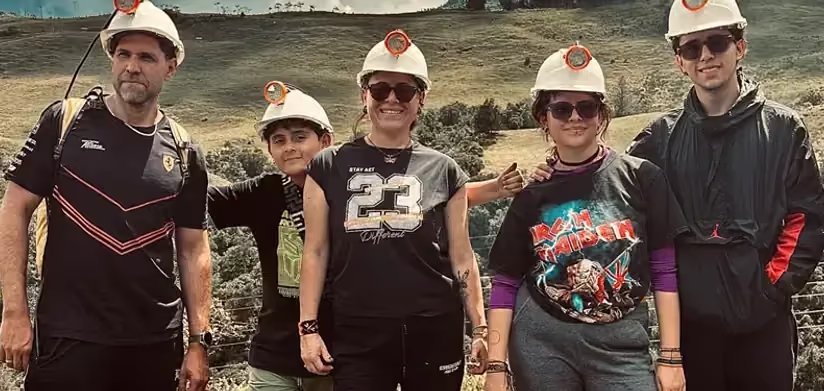
The emerald Boyacá is a different place. Tropical mountains, thick vegetation, cacao, heat. Hot, humid, campesino. We spent the first hour reconsidering the clothes in the bag.
Emeralds ignore department lines
Field notes: what we saw in the region
The emerald culture does not stop at the edge of Boyacá. It runs on into Cundinamarca, through Gachalá and Ubalá in the east, and it splits the region in two: people here say Oriente and Occidente before they say a department.
Farms, avíos and norteña music
Field notes: what we saw in the region
We came looking for mines and found farms first: cattle, honey, cacao. And food built for long days underground: avíos packed for the mine, carne oreada, nacumas. Apparently looking for emeralds makes you hungry.
The soundtrack is norteña, the accordion music of northern Mexico, playing from every car and shop between the mountains of Boyacá and Cundinamarca. It is the first sign that an emerald here rarely means luxury. It can mean the work of a lifetime.
Two belts, two ages
Eastern-belt emeralds formed about 65 million years ago; western-belt emeralds between 38 and 32 million years ago.[1]
The dates come from argon–argon analysis of green muscovite, a mica that grew together with the emeralds, so they date the mineralization itself.[1] The eastern date falls at the Cretaceous–Tertiary boundary, the moment the dinosaurs disappeared.[1] Even in age, the two regions contradict each other.
Peter Rainier at Chivor
Peter W. Rainier was the mining engineer hired by a New York consortium, the Colombia Emerald Development Corporation, to reopen the abandoned Chivor mine. He managed it from 1926 to 1931.[2]
Born in 1890 in Swaziland, “in the back of an ox wagon”, Rainier arrived at Chivor in 1926 and planted an iron stake into El Púlpito, the rock that marks the edge of the concession.[2] Under him the abandoned mine became very profitable again; by 1931 it had produced 46,250 carats, and in that same year, at the height of production, he lost control of it.[2]
He told the story in Green Fire, published in 1942, long after he had left Colombia.[3] He dedicated it in part to “Joaquin the bandit, who challenged me to a duel and was the most evil man I ever met.”[2]
Chivor, emeralds and Grace Kelly
Green Fire became an MGM film starring Grace Kelly and Stewart Granger. It opened in New York on 24 December 1954.[4]
MGM read the galleys of Rainier’s book in September 1942; a screenplay treatment followed in December 1952.[4] The film kept the title and changed almost everything else: GIA describes its plot as only vaguely similar to the book.[2]
Gachalá, Las Cascadas and the tea
With his wife Margaret, Rainier founded South America’s first commercial tea plantation at Las Cascadas, on a high slope of the Guavio valley near Gachalá.[2]
Chivor peak stood across the valley, 15 kilometers down the Guavio river. When Rainier was at the mine, he and Margaret signaled each other every night with 18-inch flashlights.[2]
Apparently emeralds were not exotic enough. Someone also had to grow tea in the Andes.
The other side of the mountain
Field notes: what we saw in the region
Mud, heat, norteña, emeralds, Grace Kelly, Hollywood and tea, and this was only Oriente. On the other side of the mountain was the part of the region we were still afraid to visit.
Sources
- Pignatelli, I., Giuliani, G., Ohnenstetter, D. et al. (2015). Colombian Trapiche Emeralds: Recent Advances in Understanding Their Formation. Gems & Gemology, 51(3), 222–259.
- Weldon, R., Ortiz, J. G. & Ottaway, T. (2016). In Rainier’s Footsteps: Journey to the Chivor Emerald Mine. Gems & Gemology, 52(2). GIA.
- Rainier, P. W. (1942). Green Fire. New York: Random House.
- AFI Catalog of Feature Films. Green Fire, Metro-Goldwyn-Mayer (New York opening 24 December 1954), based on Peter W. Rainier’s 1942 book.